The Southern Nevada Mojave Desert and the Old Spanish Trail
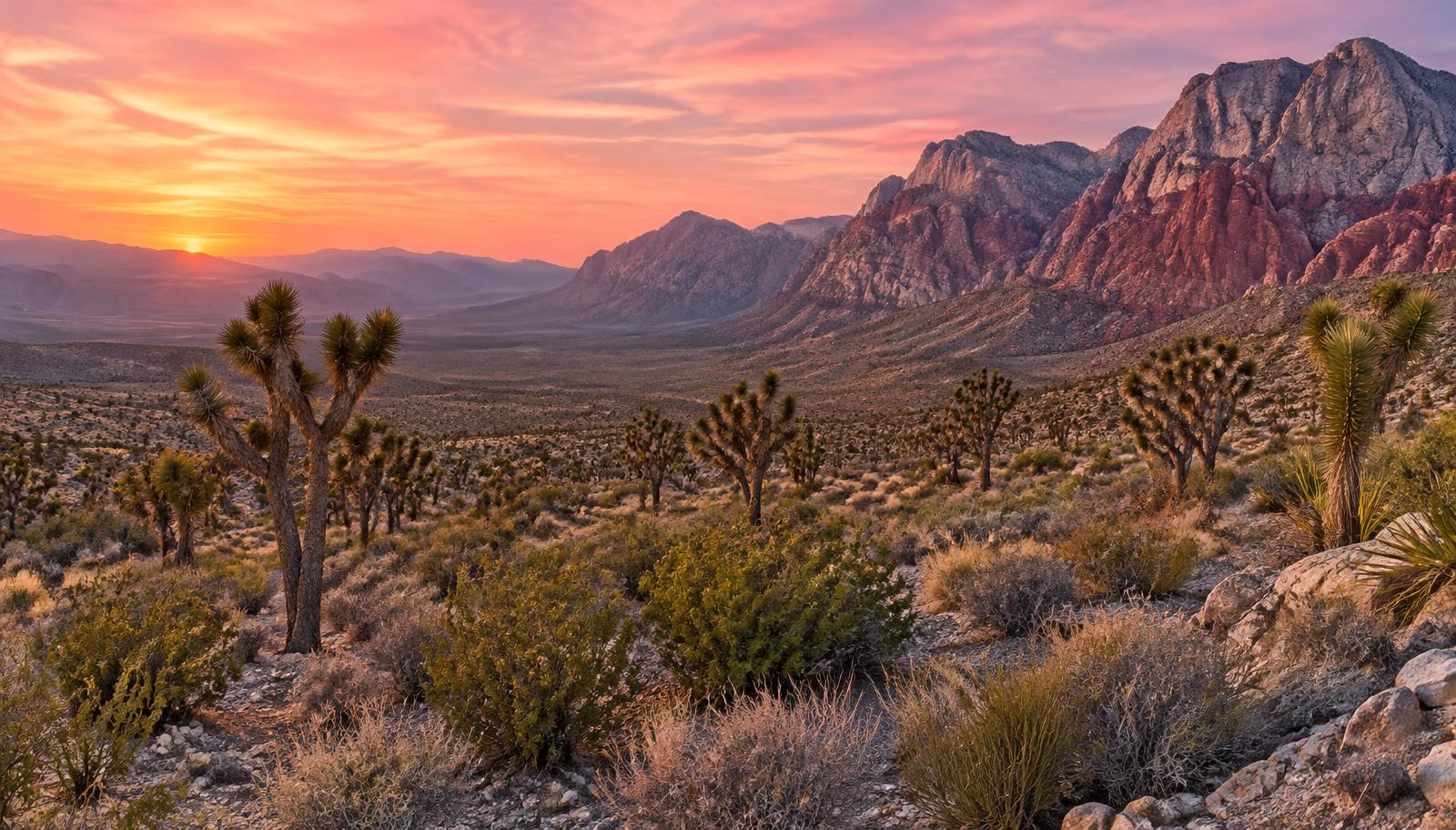
The southern nevada mojave desert is an ancient, sun-baked landscape defined by towering limestone peaks, sprawling Joshua tree forests, and natural artesian springs. Stretching across the southernmost wedge of the Silver State, this desert environment has served as a crossroads for wildlife, Indigenous trade, and historic pioneer expeditions for centuries. Modern visitors who travel just beyond the Las Vegas valley encounter an authentic frontier that remains largely unchanged since early explorers first mapped its mountain passes.
!Joshua trees and limestone mountains in the Southern Nevada Mojave Desert at sunrise
What defines the Southern Nevada Mojave Desert environment?
The southern nevada mojave desert environment is defined by extreme aridity, dramatic elevation shifts, and unique plant life that separates it from neighboring desert zones. Sitting between the high, cold Great Basin Desert to the north and the lower, hotter Sonoran Desert to the south, the Mojave is North America's smallest and driest desert. Any land receiving 10 inches or less of annual rain qualifies as desert, and the Las Vegas basin receives an average of just 4 inches per year. Winter snows atop Mount Charleston feed subterranean aquifers, producing critical surface springs that sustain life across the desert floor.
Elevation extremes and weather patterns
Elevation in this desert spans a massive vertical range. In the valleys near the Colorado River, elevations drop below 1,000 feet, while the Spring Mountains west of Las Vegas soar to 11,916 feet at Charleston Peak. This dramatic rise creates distinct microclimates. In the valley floor around Goodsprings and Jean, summer temperatures regularly climb past 100 degrees Fahrenheit, while winter nights can drop below freezing. These sharp shifts make early morning the ideal time to explore the outdoors.
Geology and natural springs
The landscape is marked by jagged fault-block mountain ranges and alluvial fans called bajadas. Rain and melting snow from the Spring Mountains seep into porous limestone rock layers. This groundwater travels through underground faults and bubbles up at valley locations. These artesian springs made human survival possible in the desert. They supplied water to the ancestral Southern Paiute people and later dictated the paths taken by Spanish trade caravans, Mormon pioneers, and transcontinental railroads.
Which wildlife and plants thrive in this arid ecosystem?
Native plants and animals survive in the southern nevada mojave desert by using specialized drought adaptations and seasonal life cycles. The ecosystem is defined by indicator species like the Joshua tree and the desert tortoise, both adapted to long periods without surface water. Creosote bushes dominate the gravel flats, while desert bighorn sheep navigate steep limestone cliffs. Subterranean burrows protect cold-blooded reptiles and small mammals from the midday heat, while deep taproots allow desert shrubs to pull moisture from deep beneath the surface.
!A Mojave desert tortoise among spring wildflowers
The Joshua tree and signature desert flora
Joshua trees (Yucca brevifolia) are the visual hallmark of the Mojave Desert. These tree-sized monocots grow only in this desert system, thriving between 2,000 and 6,000 feet elevation. They do not have annual growth rings; instead, scientists estimate their age by height and branching patterns, with some specimens living over 150 years. Alongside them grows the creosote bush (Larrea tridentata). Creosote releases a pungent, earthy resin after rain storms that gives the desert its signature smell. Clones of creosote root systems can survive for thousands of years, making them some of the oldest living organisms on Earth.
The Mojave desert tortoise and native fauna
The desert tortoise (Gopherus agassizii) is the desert's most famous resident, federally listed as a threatened species in 1990. These reptiles spend roughly 95 percent of their lives underground in excavated burrows to escape freezing winters and baking summers. They emerge to feed during peak activity windows from March through June and again in September and October. Other common desert wildlife includes:
- Desert bighorn sheep: Nevada's state animal, capable of scaling sheer rocky slopes to graze on desert brush.
- Black-tailed jackrabbits: Fast runners with long ears that radiate body heat to keep cool.
- Greater roadrunners: Ground-dwelling birds that hunt lizards, insects, and small snakes.
- Wild burros and horses: Descendants of mining pack stock that roam the foothills around Goodsprings.
How did the Old Spanish Trail cross Southern Nevada?
The Old Spanish Trail crossed the southern nevada mojave desert as a grueling pack-mule trade route linking Santa Fe, New Mexico, to Los Angeles, California. Blazed by New Mexican merchant Antonio Armijo in 1829, the trail used isolated natural springs to move wool blankets west and California horses and mules east. The 2,700-mile network was strictly a pack trail; the rocky mountain passes and deep sand dunes prevented wagons from traveling the route during its prime operating years between 1829 and 1848.
!A trader pack train crossing the Mojave toward the Spring Mountains, an artist's recreation
Antonio Armijo's historic 1829 expedition
In November 1829, Antonio Armijo departed Abiquiú, New Mexico, leading 60 men and a caravan of pack mules loaded with New Mexican woolen serapes and blankets. Traveling northwest through Utah and across the Colorado River, the caravan entered what is now Southern Nevada. A young scout named Rafael Rivera scouted ahead into the broad valley basin. He located a system of flowing artesian springs and green meadows, naming the area "Las Vegas" (the meadows). Rivera's discovery gave travelers a reliable water source in the desert, trimming weeks off previous exploratory routes. Armijo's party reached Mission San Gabriel in California in January 1830, completing the passage in roughly 86 days.
Mountain Springs Pass and the road to California
After resting at the Las Vegas springs, trade caravans pushed southwest toward the Spring Mountains. They watered their animals at Cottonwood Springs (modern-day Blue Diamond) before tackling the steep ascent over Mountain Springs Pass at an elevation of 5,500 feet. The cold spring at the top of the pass provided grazing meadows where caravans camped before beginning the descent into the Pahrump Valley. From there, traders crossed into the Amargosa River drainage, pushed across the Mojave River, and climbed the Cajon Pass into the ranchos of Alta California. The return trip with thousands of horses and mules often took only 40 days.
Why is this desert corridor historically important today?
This desert corridor is historically important because it established the transportation arteries, mining districts, and settlements that built the modern state of Nevada. In 2002, the United States Congress designated the route as the Old Spanish National Historic Trail, jointly managed by the Bureau of Land Management and the National Park Service. The trail guided 1850s Mormon settlement wagons, California gold rush prospectors, and the construction of the San Pedro, Los Angeles and Salt Lake Railroad in 1905, which directly created downtown Las Vegas.
The rise of mining at Goodsprings
In 1856, Mormon lead miners began extracting ore from Potosi Mountain, just north of the trail route through Mountain Springs Pass. By the 1890s, prospectors discovered rich deposits of gold, silver, lead, copper, and zinc across the foothills, leading to the creation of the Yellow Pine Mining District around Goodsprings. The rail lines and roads established to move ore out of these desert mines formed the backbone of southern Nevada's infrastructure. Remnants of these pioneer cabins, mine shafts, and hand-built roads still mark the foothills today.
Conservation and preservation in the modern era
Today, federal and state agencies protect large swaths of the Southern Nevada desert to preserve its cultural artifacts and fragile wildlife. Red Rock Canyon National Conservation Area and the Spring Mountains National Recreation Area offer protected sanctuaries where visitors can see the exact trails traveled by early pioneers. Historic markers, including Nevada Historical Marker No. 142 at Mountain Springs Pass, allow history enthusiasts to retrace the route of Armijo's mule trains.
How can visitors explore the Southern Nevada desert today?
Visitors can explore the southern nevada mojave desert by booking guided adventures, hiking scenic trails, and touring historic landmarks located just minutes from the Las Vegas Strip. Outdoor enthusiasts can take an offroad trail tour in a high-performance Can-Am Maverick across rugged mountain terrain, or shoot historic firearms at an outdoor shooting range set against limestone canyon walls. Historic sites like Goodsprings and Mountain Springs Pass offer easy day trips along NV-160.
Planning your desert excursion is simple with local resources:
- Off-road trail driving: Book private trail sessions across scenic mining hills at Adrenaline Mountain, located just 40 minutes south of Las Vegas.
- Historic mining towns: Tour Goodsprings, Nevada, visit the Pioneer Saloon built in 1913, and examine early twentieth-century mining equipment.
- Target shooting: Test legendary weapons like the M1919 or Barrett .50 cal at an outdoor shooting range.
- Directions and transit: Check our directions page to plan your drive down Interstate 15, or read our complete guide to combos for full-day desert adventure packages.
Photos in this article are artist's illustrations of the area and its history.
